Agilysis supports UKROEd with practical review of e-scooter and e-bike safety
UKROEd, as the governing body responsible for administering the National Driver Offender Retraining Scheme (NDORS), on behalf of police forces, commissioned Agilysis to provide a contemporary review of the evidence base on e-scooter and e-bike safety, including associated issues. Senior Consultant Samuel Scott led the project in collaboration with UKROEd.
The brief presented many questions around existing knowledge and practice, with multi-faceted challenges in micromobility safety and broader policy. E-scooters and e-bikes have become an ever-increasing part of the transport mix, but the legislation, research, as well as supporting provision to date have all not kept pace with developments. UKROEd sought an actionable review of where the evidence currently stands, to support the organisation’s proactive approach to vulnerable road user safety in collaboration with partners across the professional policing landscape within which it operates.
What did the review need to answer?
The review was structured around three tasks. The first synthesised evidence on e-scooter and e-bike safety: including on injury risk, demographic profiles, trial data, and local enforcement approaches. The second task laid out the legal position for both modes in the UK, including regulatory gaps domestically and further afield. The third task was to assess what the review means in practice for educational-based interventions, including for both the NDORS scheme itself, as a suite of offender rehabilitation courses, alongside UKROEd’s wider supporting role spanning education and enforcement.
The brief involved consultation of a wide range of material ranging from peer-reviewed literature, government and policy reports, parliamentary inquiry evidence, coroners' findings, in addition to policing case studies and media reports. Micromobility research is still in its infancy, with much of what is known coming from grey literature and practical experience rather than an academic consensus.
Why are the challenges so acute?
Part of the answer is that e-scooters and e-bikes occupy different legal positions. Private e-scooters remain illegal on public roads outside government-backed trial areas, where they're currently permitted under amended regulations; and have already been extended five times, most recently to May 2028. E-bikes, by contrast, are legal providing they meet existing EAPC (electrically assisted pedal cycle) rules, putting them on the same footing as conventional pedal cycles. Non-complaint EAPCs however must meet the appropriate moped or motorcycle requirements - although in reality they are not registered, tax or insured with notable issues in the gig economy. Whilst research and evaluation in this area have increased in recent years, modal specific and shared issues both appear to be growing policy problems in need of remedy – if the benefits are to outweigh the risks. Safety, active travel and integrated transport goals will all be affected by prevailing patterns and developments for these modes.
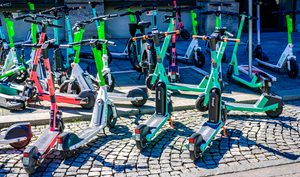
Trial e-scooter use (via shared rental schemes) is relatively well understood. Trial usage has amounted to over 3.5 million users and over 70 million trips since July 2020. Private ownership is a different story. Estimates put more than 1.2 million private e-scooters in circulation, with fewer than 25,000 rental units available. PACTS has estimated the split between private and trial e-scooter use at roughly 82:18. Over half of injured e-scooter users in DfT data were riding a private device at the time, and a further sizeable share of casualties often cannot be classified.