The Agilysis team of Nathan Harpham, Drishti Khatri, Dan Campsall, and Richard Owen have spent the last few weeks reviewing the new road safety casualty reduction targets with the aim of seeing how close we may get based on previous performance. The results are in some ways promising, but still fall way short of the requirement. Read on to learn more about the targets, prior performance, our modelling methodology, and how policy changes can help make rapid progress.
On 7th January 2026 the Department for Transport launched the new Road Safety Strategy and with it introduced the first national casualty reduction target for 15 years. The last set of targets (40% KSI reduction) were backed by significant funding, and ran until the end of 2010. They were achieved one year ahead of schedule and came during a period of significant technological advances. Safety equipment for vehicle occupants improved dramatically, there was a widespread rollout of speed enforcement technology, significant efforts were made on road safety engineering through local schemes, and lower speed limits started to be introduced on some roads. It is very hard to say which of these interventions was most successful but the evidence seemed clear that a multitude of changes across the road system impacted upon the casualty figures. It should also be noted the two long periods of snowy weather across much of Great Britain impacted on the casualties due to reduced traffic and speeds.
Given the success of the last set of targets, it seems strange that they were not followed-up, almost certainly a political decision by the Coalition Government. Instead we received predictions; estimates of where casualty number may be headed if ‘things carried on’. The forecasts, undertaken by TRL, were included in the Strategic Framework for Road Safety, published by the DfT in 2011. They were not strict statutory targets but trend-based projections used by ministers, officials, and analysts to judge how casualty numbers might evolve and to assess potential impacts of continuing or new interventions. Without a target to be owned however, nobody really paid any attention to them and they weren’t reported on with any regularity.
The central projection for the KSI figure was 18,070 by 2020. The actual figure was 23,765 which in itself was much lower than the previous year (30,371) due to COVID lockdowns. By now we had entered the era of adjusted severity calculations. This is now the preferred way for reporting those killed and seriously injured as it allows for critical differences in reporting systems used by police officers, thus providing a more accurate and comparable method of examining historical trends(more information can be found on the work of the ONS and DfT via the gov.uk website). It was clear that the predictions did not come true, the large decreases seen in the period 2005 – 2009 did not continue in the 2010s with a significant period of stagnation.
We now have a new target, a 65% reduction in (adjusted) KSI casualties which means a target number of 10,349 (this will change over time due to the nature of the adjusted severity formulae). That’s a very big drop which would be welcomed by everyone, but is it realistic? We did our best to find out.
At Agilysis we do have some history of calculating these predictions. We helped the Scottish Government in 2019 (https://www.transport.gov.scot/media/48832/development-of-scotlands-2030-road-safety-casualty-targets-and-key-performance-indicators-september-2020-updated.pdf), and published the GB Road Safety Index in 2021 with the Vision Zero Foundation and PACTS (https://agilysis.co.uk/wp-content/uploads/sites/25/2021/11/GB-Road-Safety-Performance-Index-Report.pdf ) that carried out forward projections to 2030. We have also carried out this work at a local level, usually for regions, but things can get quite difficult when working with very small numbers in individual authorities.
This new analysis aims to present future KSI trends in two scenarios:
- The KSI trends from 2005-09 (following the last government strategy with targets and more meaningful progress) are repeated from 2026 to 2035
2.The KSI trends from 2010-19 (during the decade of more stagnating progress) are repeated from 2026-35
These are then compared with the KSI trend needed to reach the government 65% reduction target in 2035.
To project KSI casualty numbers to 2035, historic casualty data and DfT traffic data were taken into account. A log-linear regression was used to understand the reduction in KSI rates between 2010-19 and 2005-09 separately. These two trends were then projected forwards to 2035, assuming that KSI rates decay at a fixed percentage rate per year, from a starting point of the 2022-24 baseline.
Adjusted DfT traffic projections, based on more recent actual data, and extrapolated Scottish traffic data were then used to account for exposure and compute the absolute number of KSIs in GB to 2035.
We have used casualty data for those killed or seriously injured using the 'adjusted severity' data rather than the officer recorded severity.
The DfT Baseline KSI figure is currently 29,568 for the period 2022-2024. This means we are going to have to get close to 10,000 KSI casualties whilst at the same time, traffic figures are projected to rise. This means that, relative to traffic, we will need to see closer to a 70% reduction in the injury rate.
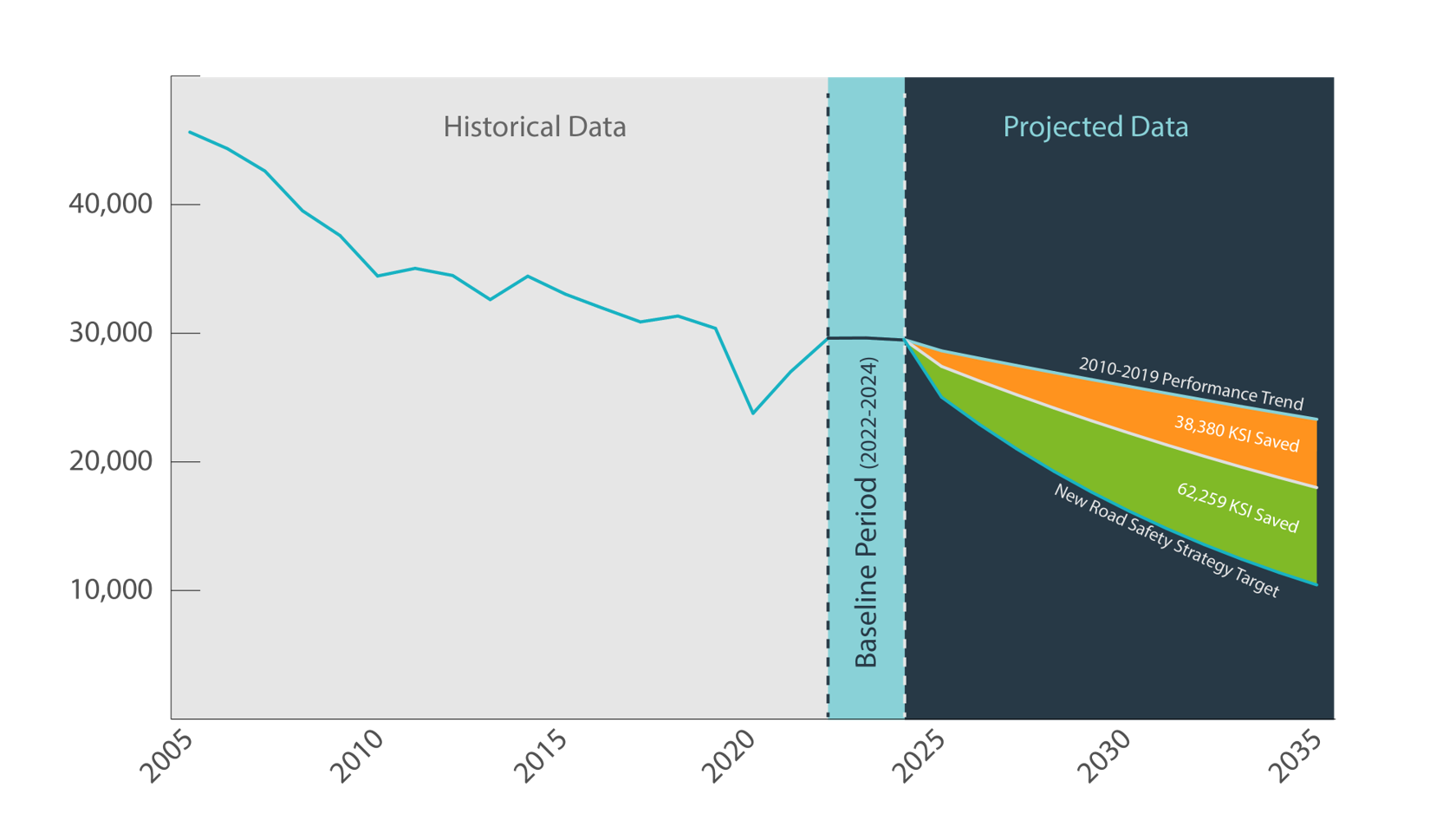
How close do our projections get? Well, using the most recently observed progress we only hit 23,253 KSI casualties by 2035. That’s still a reduction of 6,315 casualties per year for 2035 and an estimated total saving of 38,330 over the entire period. It’s still a long way off the target though. This casualty reduction rate of 2.91% per year is nowhere near the 9.25% needed to achieve the target in our model.
What if we saw more rapid progress? What if we achieved casualty reduction at the rate seen between 2005 and 2009? Here the results are better, we would get to 17,931 KSI casualties by 2035, a total saving of 62,219 KSI casualties over the period. It’s still only an annual rate reduction of 4.99% though.
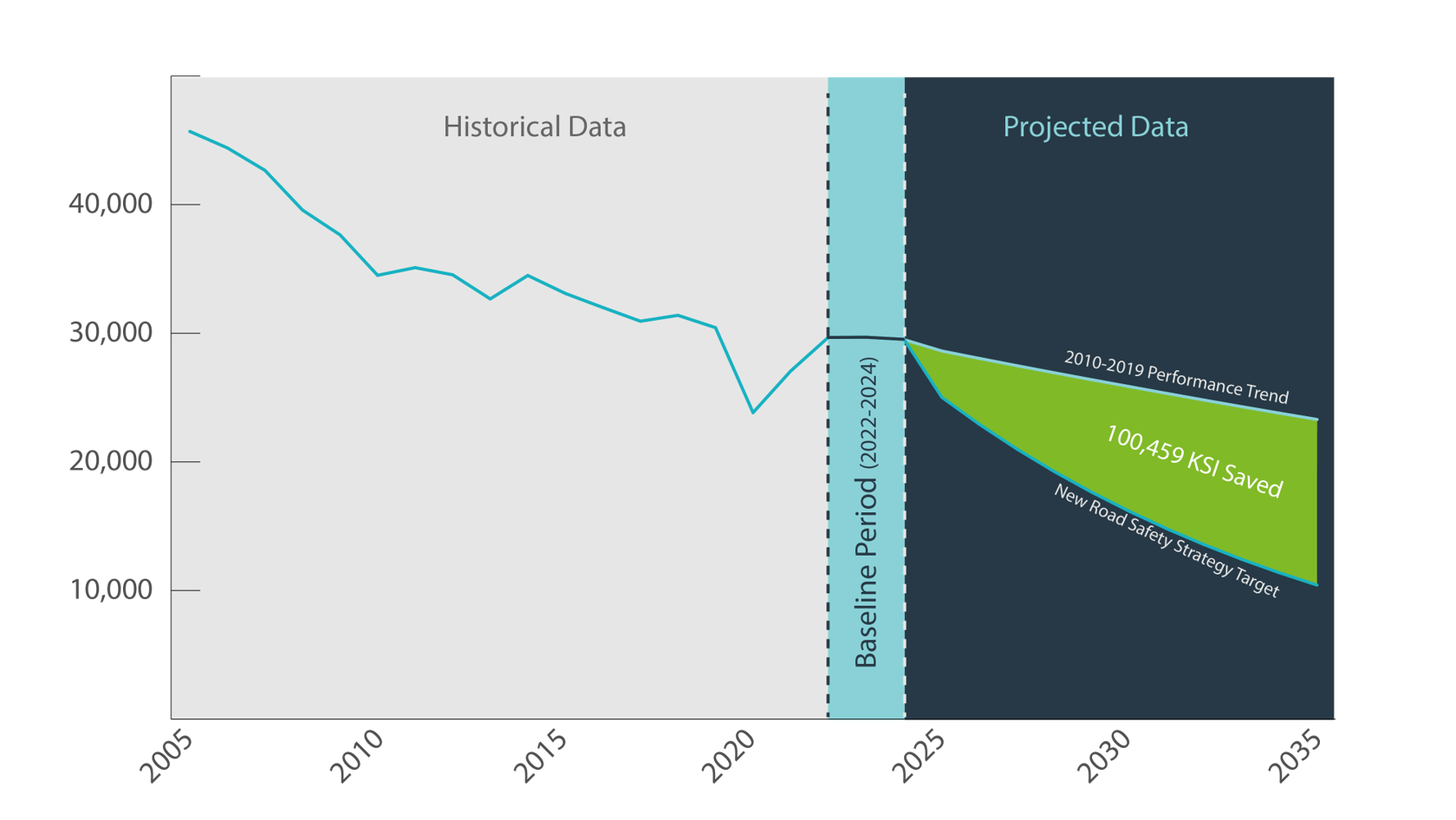
The total casualty saving on offer if we achieve an annual reduction of 9.25% is a massive;100,459 KSI casualties over the period after the baseline (although this includes 2025, the year before the strategy was announced).
It seems to be a very difficult target, and with this kind of ambition we will need to see radical change - much greater improvements in technology, funding, policy, and legislation than have ever been seen before. Sounds impossible? Well perhaps not.
There are some policies that we know have a large effect; take speed limit changes for example. In Wales when a default 20mph speed limit was implemented there was a 12.7% reduction in KSI casualties in urban areas in the one year after implementation (October 2023-September 2024).
We know that prior to the change in policy around 10% of urban roads in Wales were 20mph rising to around 90% after the change (https://www.gov.wales/sites/default/files/publications/2024-05/20mph-default-speed-limit-review-of-exceptions-final-report.pdf). Research by Insight Warehouse (https://speedmap.co.uk/wp-content/uploads/sites/45/2025/10/Insight-Warehouse-Great-Britain-20mph-Analysis-2025.pdf ) shows that outside of Wales, around 27% of urban roads are currently 20mph which means that not all of the observed 12,7% reduction is ‘available’. It is therefore possible to give an indication of the available casualty reduction, if 90% of urban roads in England and Scotland changed to 20mph. The calculations are shown below:
|
England and Scotland urban 20mph by length |
27% |
|
Wales urban 20mph by length |
90% |
|
Difference |
63% |
|
Wales 20mph increased by |
80% |
|
Wales KSI reduced by |
12.7% |
|
England and Scotland proportion ‘available’ |
10.0% |
|
England and Scotland urban annual average KSI (22-24) |
16549 |
|
England and Scotland projected reduction |
1,648 |
A reduction in KSIs of 1,648 is achieved immediately following implementation and is a one-off impact, although the total contribution to the target in the strategy is significant. If we switched speed limits today, we may expect a total KSI casualty reduction of over 16,000 over the next 10 years, contributing around 1/6th of the total number of casualties we want to save.
There are caveats around this analysis of course. We would certainly like more data on the collision reductions in Wales, and there may be other local factors influencing the results. Nevertheless, it starts the conversation and is a good indication of how we can begin breaking down the casualty reductions required in the strategy and hence thinking about the bold action that will be required to achieve them.