Over the past decade, 20mph has become one of the most widely adopted road safety interventions across the UK. For many road authorities, the question is no longer whether to introduce it, but how to ensure it delivers meaningful and demonstrable safety outcomes.
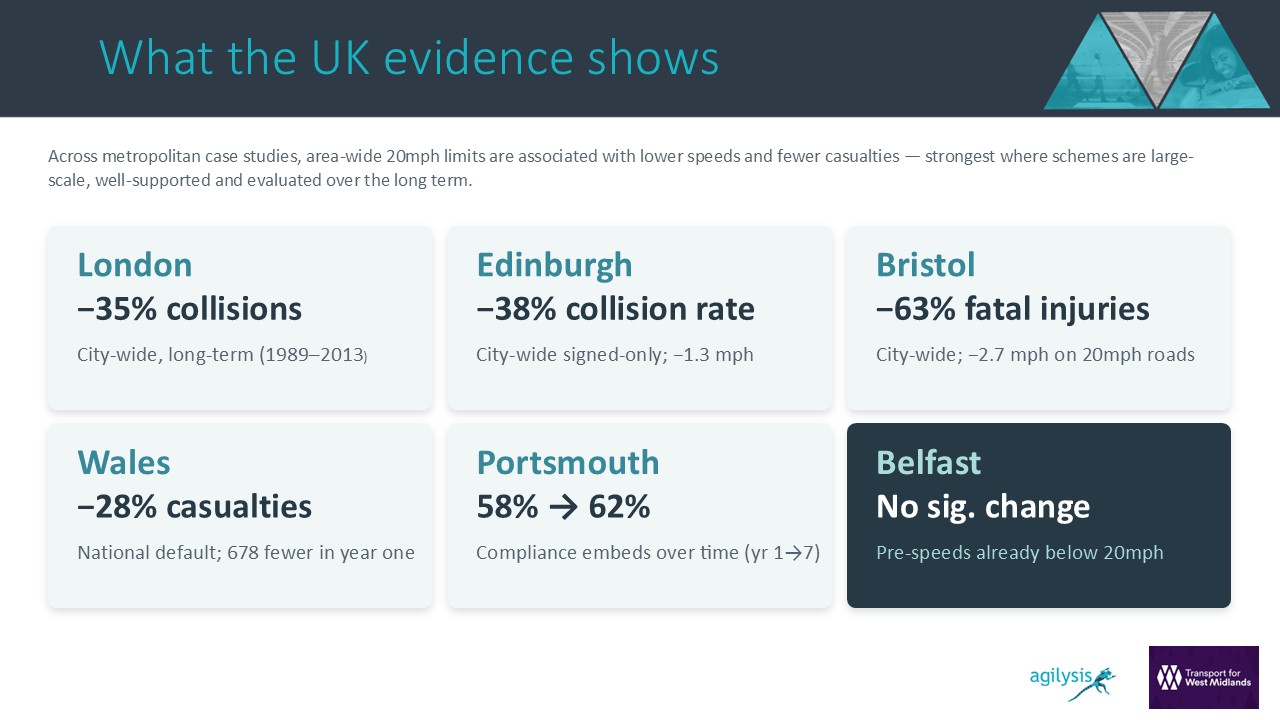
When we look across UK schemes implemented at scale, the safety benefits of 20mph are both clear and significant. City-wide and national programmes provide the most robust evidence because they remove many of the variables that affect smaller schemes. Current evidence already demonstrates significant safety improvements following their implementation.
- In London, long-term implementation of 20mph has been associated with a 35% reduction in collisions.
- In Edinburgh, a city-wide rollout delivered a 38% reduction in collision rates.
- In Bristol, one of the earliest large-scale adopters, fatal injuries reduced by 63%.
- In Wales, the introduction of a national default 20mph limit resulted in a 28% reduction in casualties in the first year alone.
20mph consistently proves itself to improve safety outcomes when applied at scale and sustained over time. The reason these results are so consistent is that the relationship between speed and injury severity is already well established.
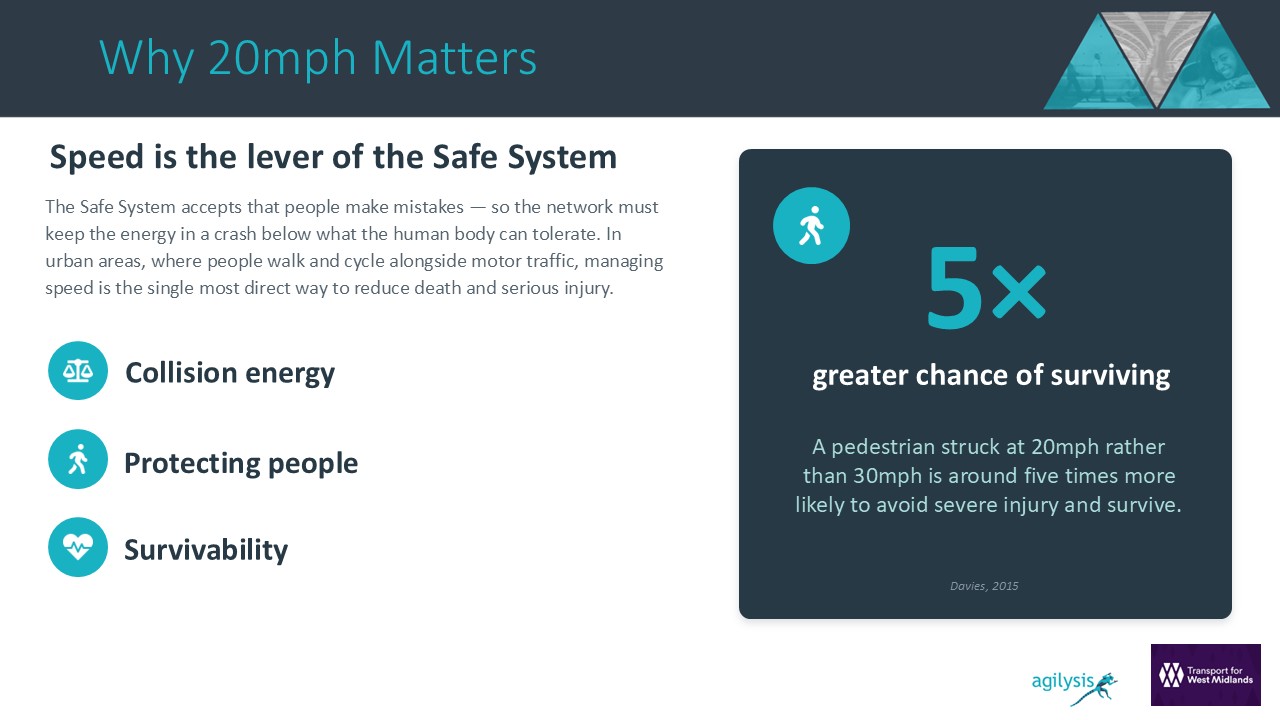
Lower speeds reduce both the likelihood of collisions and, just as importantly, the severity of the outcomes when they occur. The difference between 20mph and 30mph materially changes survivability in the event of a crash.
This is why 20mph repeatedly sits within Safe System thinking. It directly controls the energy involved in a collision, and therefore the consequences for those involved. From a strategic perspective, it is one of the few interventions that operates so directly on the core drivers of harm.
Why outcomes vary between locations
Despite this strong evidence, outcomes are not uniform across all schemes. Some deliver significant casualty reductions, while others show more modest short-term impact.
Understanding this variation is essential for any road authority planning or evaluating a 20mph programme. The most important factor is the starting point, specifically, the speed of traffic before the limit is introduced.
Where pre-implementation speeds are higher, 20mph delivers more substantial reductions in speed and, consequently, more visible improvements in safety. Where speeds are already low, the measurable safety effect is naturally smaller because much of the risk has already been removed.
International evidence consistently supports this, identifying baseline speed as a defining factor in the scale of safety benefits.
Our recent work with Transport for West Midlands provides a clear, practical example of this relationship. We combined a comprehensive evidence review with a detailed analysis of 20mph roads across multiple authorities, using both collision and connected-vehicle data from TomTom to understand real-world outcomes.
Across the West Midlands, baseline speeds were already comparatively low. In Birmingham, for example, average speeds were around 16.8mph before the introduction of 20mph limits.
Understanding this context, the results in the West Midlands aligned with what the wider evidence predicts. Average speeds decreased slightly, with larger reductions on higher-speed roads. Meanwhile collision numbers showed a small increase, although this was not found to be statistically significant.
Without context, these results may be misinterpreted by some. A limited short-term change in collisions may be seen as underperformance, when in reality it reflects an already lower-risk network.
Indeed, examination of the longer-term trend reveals a far greater (22%) reduction in collisions again aligning with the findings internationally of compliance embedding over time.
This highlights the importance of evaluation as part of the strategic exercise. Understanding the baseline risk so that interventions can be targeted for the greatest impact, so that outcomes can be interpreted accurately.
The role of high-quality data
In the West Midlands study, TomTom connected-vehicle data was used to measure speeds across the network. Its large sample size means that we can confidently provide a consistent, large-scale view of how vehicles actually move, rather than relying on isolated spot measurements.
Using this type of data allows authorities to understand behaviour at the network level, identify where risks remain, and measure how those risks change over time, thereby building a continuous evidence base for decision-making.
20mph is just one tool within a broader Safe System approach. At a time when budgets are increasingly constrained, every intervention needs to be targeted where it will have the greatest impact and supported by evidence that demonstrates it is working.
This is where a more data-led approach becomes critical. Authorities need to understand their network, identify where risk is highest, and apply the right interventions with confidence. Equally, they need to be able to measure outcomes clearly, both to inform future decisions and to demonstrate value.
At Agilysis, we support authorities to do exactly that. By combining high-quality connected vehicle data with robust evaluation methods, we help clients target 20mph and other safety interventions more effectively, understand the real-world impact on speeds and collisions, and build a credible evidence base for ongoing investment.

Principal Consultant