The UK government’s new road safety target – a 65% reduction in people killed or seriously injured (KSI) by 2035, represents one of the most ambitious commitments made in recent decades. With the five national road safety consultations now closed, the latest episode of The T Junction podcast explores what this target really means in practice, and whether it can realistically be achieved.
Hosted by Steve Ferris and joined by Agilysis consultants Nathan Harpham and Drishti Khatri, the episode takes a clear, evidence led look at historical trends, current policy proposals and international experience to assess the scale of change required.
Learning from the past
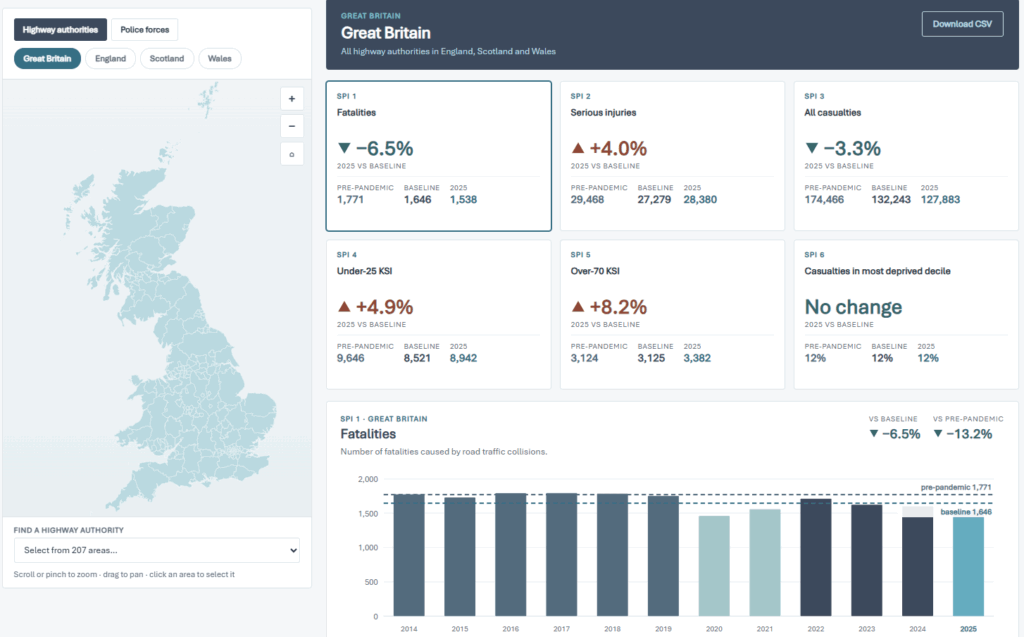
To understand the challenge ahead, it is essential to look at previous casualty‑reduction performance. During the period from 2005 to 2009, the UK achieved average annual reductions in KSIs of around 5%, supported by a strong national target, speed management, enforcement and major improvements in vehicle safety.
However, progress slowed significantly after 2010. Between 2010 and 2019, reductions averaged closer to 3% per year, leading to a broadly stagnating trend. Against this backdrop, a 65% reduction by 2035 would require sustained reductions of approximately 10% year on year – double the best performance seen in recent decades and more than triple that achieved during the period of stagnation.
As discussed in the podcast, achieving this level of improvement would represent a genuine step change rather than an extension of existing trends.
What does the current strategy offer?
The episode also examines what the current road safety strategy and associated consultations could realistically deliver. The strategy is firmly aligned with Safe System principles, and includes a number of evidence‑based proposals such as longer minimum learning periods for young drivers, mandatory eyesight testing, updated speed limit setting guidance and revised road safety education guidance.
These measures provide a strong foundation, but many remain under consultation or have yet to be fully implemented. As a result, their eventual impact will depend heavily on the detail of delivery, including funding, enforcement, scale and consistency across the network. At this stage, it is difficult to reliably quantify how much each measure might contribute to reducing KSIs.
Focusing on the highest‑risk groups
A key theme throughout the discussion is the importance of targeting interventions where risk – and therefore opportunity – is greatest. The episode highlights several groups that account for a disproportionate share of serious harm on UK roads.
Young drivers aged 17 to 24 represent a relatively small proportion of licence holders, yet are involved in a far higher share of fatal and serious collisions. At the other end of the age spectrum, the number of drivers aged over 70 has increased sharply, with older drivers now accounting for a growing proportion of road deaths. Motorcyclists also remain over‑represented, accounting for a significant share of fatalities despite forming only a small proportion of traffic.
Each of these areas represents a substantial opportunity for casualty reduction if addressed effectively.
How far could bold action take us?
Drawing on recent analysis, the podcast explores the potential impact of large‑scale interventions such as widespread 20 mph limits on urban roads, lower rural speed limits, full graduated driver licensing and mandating a comprehensive suite of vehicle safety technologies.
Even with broad assumptions based on the best available evidence, these measures combined might only deliver around half of the required 65% reduction. The implication is clear: incremental change alone will not be enough to meet the target.
Leadership, accountability and learning from others
Beyond individual interventions, the episode emphasises the importance of leadership, culture and accountability. International experience shows that ambitious targets are most effective when supported by clear national action plans, strong political leadership and regular monitoring through safety performance indicators.
Examples from countries such as Norway, as well as successful city‑level initiatives closer to home, demonstrate that significant reductions are possible when Safe System principles are applied consistently and at scale. However, the discussion also highlights that targets alone are not sufficient – they must be backed by action, innovation and sustained commitment.
An ambitious target – and a real opportunity
So, is a 65% reduction in road casualties by 2035 realistic? The target is undoubtedly ambitious and will require a fundamental shift in how road safety is planned and delivered. But ambition matters. Clear targets focus attention, drive accountability and create the conditions for meaningful change.
With the right mix of Safe System interventions, strong leadership and learning from international best practice, the target represents not just a challenge, but a critical opportunity to reset the UK’s approach to road safety.
T-Junction 10: Can We Really Achieve a 65% Road Casualty Reduction by 2035?